Venice represents a unique situation... in our imagination, Venice is a non-place ante litteram....
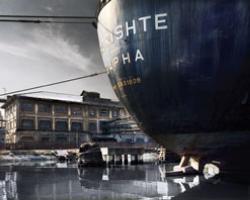
Luca Campigotto was the only one who chose an area that lies outside the city proper, by working in Marghera. The post-industrial atmosphere of heavy metal and corrosive rust is made sublime by an extraordinary rendering of the light, and of course, the colours. Campigotto has been successful in his desire to find beauty in the place where it is least likely to be found in Venice. His pictures make spaces highly defined, compressed into the saturation of colours and the metallic, physical presence of the sky that holds the ships, the structures, and the harbour loading cranes boxed inside the images. As I mentioned, Campigotto is Venetian and is obviously familiar with atmospheres, points of view, and places that presuppose many generations of belonging to these places. But above all, what he has instinctively is a gaze that starts from within and opens doors onto perceptions of unknown “exteriors”. In these images, the assimilation between the materials of the elements contained is what signifies the “Venetian-ness”, something we are only able to intuit a posteriori. Sky, water, metal, earth, stone, from a never-before-seen unity, like at certain times of the year when the high waters, the lowering sky, and the houses overlooking the canals lose their physicality, forming a material state that is undefinable and unique. This is Venice for Campigotto, a mysterious city in a state of slow transformation, subject to the corrosion of the elements and time. His gaze is lucid, permeated with a melancholy that is objective, unburdened by the kind of sentimentality that often invalidates Venice.
from the exhibition catalogue Flashes on water, 2006
|
|